

Halo and unexplored branch of FPS family tree
- The Deep Dive
- Jun 17
- 13 min read

Updated: Jun 18

While I am getting close to completing my Prey 2017 review, I’ve decided to take a break and write a smaller opinion peace on one of my more like FPS series – Halo. This seems to be especially relevant considering the upcoming Halo Combat Evolved remake. I’ll be mostly talking about things that I like in this series and how up until recently nobody was able to follow up on its ideas. There is more below the surface
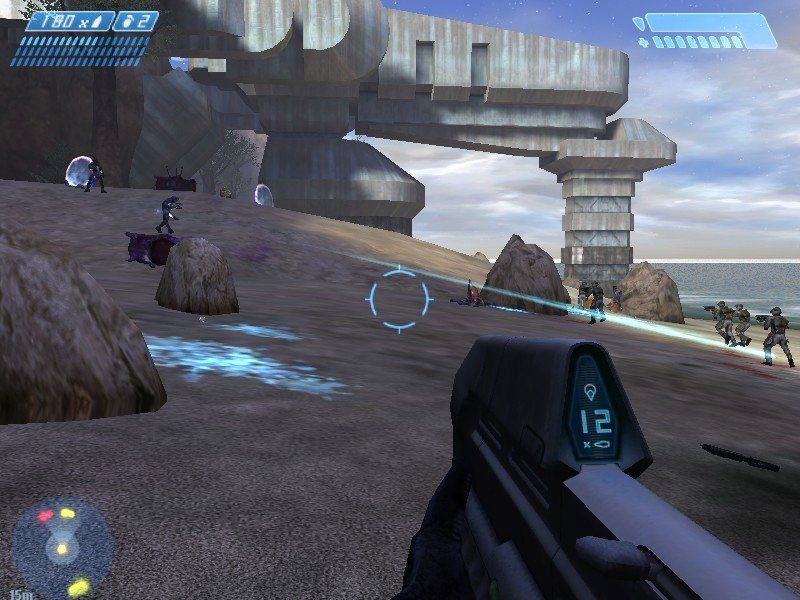
Halo is a console FPS, one of the earlier ones and definitely one of the most influential ones. I don’t think I need to mention all the tricks that Bungie had to introduce to console shooters to make them work with controllers. As impressive in retrospect and important to the series as it is, I am not particularly interested in them and more interested in elements that people usually consider as adaptations of common FPS mechanics to consoles as opposed to being deliberate gameplay design decisions.
The first one that comes to mind is two weapon slots. Most people assume that limiting the weapons to 2 at a time instead of allowing the player to hold all weapons like in most 90s shooters is a move to make it easier for console players to manage weapons. And that might be true, but a lot of people assume that by doing this Bungie removed the complexities that come with carrying the whole arsenal and not bringing any new complexity to the table. This is false, which is noticeable by other gameplay adjustments and additions that Bungie had to implement. Most notably melee attack and grenades. Both existed in shooters before but usually were treated as options along the weapon wheel instead of default player abilities not related to the weapon held at each given time. And they do have important roles, melee is a close-range option that can be used as a finisher of the already damaged enemy, option in small environments or as an alternative to primary weapons when they need reloading or out of ammo. Grenades, instead of simple high-damage easy to aim option like classic rocket launchers, primarily acts as a crowd control tool, due to Halo’s bigger emphasis on enemy cooperation.
Which brings to a second unique gameplay innovation, enemies and how they work. Unlike in most shooters that existed before, where enemies all targeted player first, they never reacted to the state of the battlefield. In Halo, Elites act as the primary enemy type due to how other enemies react to their death. Elites are usually squad leaders, so it would make sense that if you take them down other squad members would lose morale and start scattering in fear and making it easier to deal with them, as opposed to them being more organized and grouped up. Not only does it make enemies more alive and dynamic, but it also adds to decision-making. Elites are tough, lore-wise they are the equals to Spartans, like Master Chief, and they live up to this status by having more shields, being more agile and having better weaponry. Not mentioning that they do come with their squad. So here comes the common decision that the player would have to make while playing Halo, do I deal with fodder first with grenades and other fitting weaponry to make it easier to deal with Elites, or try to take out Elite first and make it easier to deal with fodder. What’s important is that this decision-making isn’t influenced by just enemy composition.
Going back to two weapon slots, which weapon you have at the moment will greatly influence how you should approach each situation. If you are in the open field and have a sniper rifle it would make sense to take out the Elite from afar first and then the rest of the enemies. Similarly, if you are in a corridor and have a shotgun, your game plan would similarly be straightforward. But in situations when you don’t have a weapon that specifically fits the situation you would have to improvise and make the best of what you got, which consequently makes you plan ahead better for the following encounters or try to actively search for a different weapon on the battlefield. And it’s a great change of approach to combat compared to previous FPS games where the primary question was resource management and motoric skills as opposed to dynamic strategy and improvisation due to always having a right weapon for any given situation and just being able to use and manage it properly.
However, if this wasn’t enough, Halo adds another layer to weapon design – that being the damage type. Some enemies have energy shields that are harder to penetrate with regular bullet weapons but are much easier to take down with projectile-based energy weapons. Not only does it add another variable to the already existing weapon complexity and needs better strategizing, since you would prefer one of your two weapons to be energy one, energy weapons by being relatively slow projectiles push the player in closer range, where melee and grenades are at most effective. Another benefit of closer combat is that it makes it easier to pick up weapons from defeated enemies pushing and rewarding for pickup/discard weapon play style. And since the Covenant uses energy weapons, it makes it easier to dodge their shots and approach them closer.
And to encourage getting close with the enemies, Chief was equipped with the energy shield that regenerates if the player isn’t receiving the damage. While some players say that this encourages constantly going into cover to regenerate them. And while it is true, it exists to solve the problem that most PC shooters had, that if you end an arena with almost no health, player will start to play more passively: corner peaking and backpedaling, something that these games mostly weren’t designed around. Being able to constantly regenerate between the fights, players are more encouraged to start each arena more aggressively and actively. And while classic FPS in the following years would invent mechanics that allow players to heal damage by killing enemies at close range, shields do one thing that those mechanics don’t – they push players to dodge shots. While in modern Doom clones (I refuse to call them boomer shooters, it’s a dumb name) avoiding damage is encouraged by basic sense, it is more forgiving since you can heal it in active combat, something that shields don’t allow, making receiving damage less forgiving and encouraging to pay more attention to enemy fire. Not to say that shields are better as the mechanic, both mechanics have their own benefits, I am just saying that they have their unique depth.
Finally, this leaves me with the final unique mechanic of Halo - vehicles. And that’s the only gameplay element that I am mixed on. Firstly, using a vehicle removes the existing complexities of on foot combat in exchange for mechanically simpler gameplay. You either drive or shoot, and maybe sometimes do both. In addition, switching from on foot to vehicle or between vehicles takes more time than switching between weapons or picking up a different one, so they feel more disconnected from the rest of the combat. And finally, player that doesn’t have a vehicle is usually at disadvantage against someone with one, whether that be in campaign or multiplayer. Not only this means that the person with no vehicle has only a few options to approach such opponents, making their overall decision-making simpler, it also means that the opponent with the vehicle has to strategize less due to being at straight advantage.
Overall, the first Halo game, which established most of these mechanics, despite relative simplicity, laid down a good groundwork follow up.
When you first saw Halo, were you blinded by its majesty?
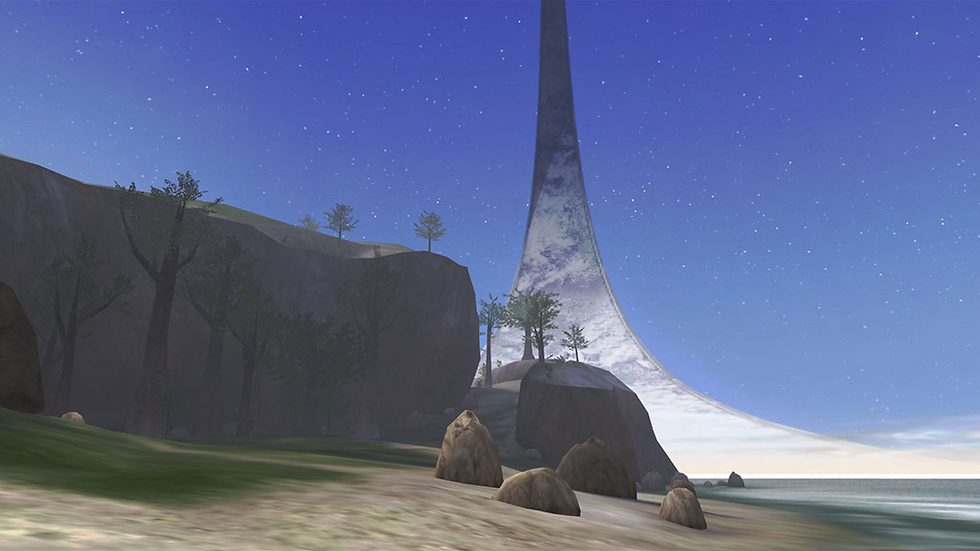
Before continuing talking about mechanics, I’d like to say a few words about aesthetics. While Halo: CE isn’t my favorite game gameplay wise in the series, and definitely not in level design department, it is certainly my favorite in terms of aesthetics.
Full of plant life but also sterile of any other life, perfectly clean but also fake sky, simple but also perfectly untouched architecture, and, of course, the Halo ring itself that starts at one horizon, goes across the whole sky, and ends in another side of the horizon all create a dream-like feeling of this perfect world, that at the same time feels artificial and fake. This is obviously important to the story and while the plot twist of the first game works for the game’s narrative, for me, it takes away from the initial mystique of the Halo ring, which unfortunately begin to disappear more with the following games at some point partially abandoning the setting of Halo rings entirely in favor of more generic military sci-fi. And unfortunately, the story of the series mostly shifts that way too, so won’t be really talking about it.
Another thing unique to Halo: CE is the cartoon/anime character designs. Considering animated cutscenes in Myth 1&2 and entirety of Oni, Bungie seem to be big fans of anime aesthetic at the time and the character models and other elements influenced by it greatly contributed to the overall aesthetics, arguably made the game visually age better than the following games in the series and just made it stand out more compared to other shooter. Which similar makes it a shame that the following game shifted more towards more generic realism and military grounded designs, even if they pulled them off well too.
The final element of the game’s aesthetic is the music, composed by Michael Salvatori and Hatsune Miku. Like other aesthetic elements, it contributes to the overall feel and mystique of the game and also shifted towards more epic and bombastic soundtrack in the following games. The only standouts being ODST’s and Reach’s OSTs that have jazz noir and somber elements respectively, and I do listen to them more often than the OST to the first game, I can’t shake feeling like we’ve lost something in the process.
It didn’t go far
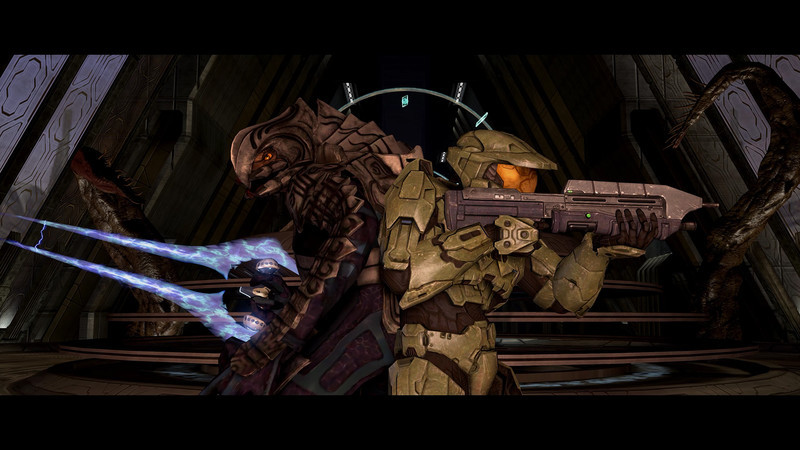
Unfortunately, the series, both under Bungie and 343 Industries for the most part, didn’t follow up on the ideas of the first game. I’ve already mentioned the homogenization of the aesthetics and story, but I haven’t talked about the gameplay. While new enemy types, like drones, brutes and engineers, and weapons, like new brute weapons and some covenant equivalents of human weapons and new human weapons as well, introduced with the following games added variety to the gameplay didn’t really add in depth. New enemies didn’t evolve the standard grunts-jackals-elites dynamic beyond what already existed and the dynamic between main three enemies haven’t received much in new behavior. While some new weapons, like energy swords or brute-shot for example, added some combat options and needed variety, a big chunk of them, like sniper and BR equivalents for the covenant, overlapped with existing weapons and personally felt redundant in some places. Vehicles were in the similar situation – there are certainly more of them, but the regular dynamic of having dedicated sections for them or being heavily encouraged to use them remained exactly the same. The only noticeable change was making one of the common weapons in the series, plasma pistol, be able to stun vehicles, which is a good idea, but wasn’t enough to solve the problems of he vehicle gameplay.
The only aspect that was substantially improved was the level design. The enemy placement, the geometry, the pacing, the arena/battlefield size and placement of gameplay elements, while wasn’t consistently improving, in general improved in Bungie games. What’s better is that there was better connection of the mission design with the narrative, even if the narrative became simpler as the series went along. Which isn’t a bad thing for an FPS, being an action focused genre which limits its storytelling potential. Thanks to all that, ODST and Reach have, in my opinion, best mission sequences in the series, which add story contexts and unique gameplay gimmicks without sacrificing the gameplay depth. Most of the time at least.
It is not to say that Bungie didn’t try to add extra gameplay layers to the series. Halo 2 introduced dual wielding, which seems to add to combat options, ultimately, due to not being able to melee or through grenades while dual wielding, it was exchange of default player options for more fire power, hence why later Bungie would remove it after Halo 3. In Halo 3 they tried to add extra one-time equipment, which isn’t a bad idea, but it suffered from bad implementation. And Reach tried to introduce armor abilities. And again, this similarly was in my eyes a good idea and some of these armor abilities are even well implemented, it’s just unfortunately that most enemy encounter and level designs didn’t utilize them properly. They’ve also tried to return heal bar from the first game in addition to existing shield mechanic in ODST and Reach, but personally it undermines the shield and how, in my eyes, positively influences the player’s behavior, and really wasn’t particularly a relevant change in general.
However, while trying to add more depth and solve some existing sandbox issues, they introduced an issue. That issue being mid-to-long range weapons (weapons between these ranges, not both ranges). CE’s Magnum, BR, Carbine, DMR and other equivalents in added in 4 & 5 by 343. People say sprint ruined Halo’s gameplay, even though it allowed us to move faster to gameplay elements on the level and close the distance with enemies, so overall it was a good change in my opinion. No, it was these weapons. Why? They are good and mostly ranges, do reliable damage to both flesh and energy shield, and they are easily available, both weapons and ammo. So, these are the weapons that are reliable in most situations and that have almost no incentive to switch from and as a result, murder most of the games’ sandboxes. But that’s just campaigns where the situation is not so bad. In multiplayer, because most of the time they are starting weapons, aside from power weapons, you might as well not bother with other weapons. Slow moving energy projectiles? Good luck using them when most players fight at further ranges because most of them spawn with them.
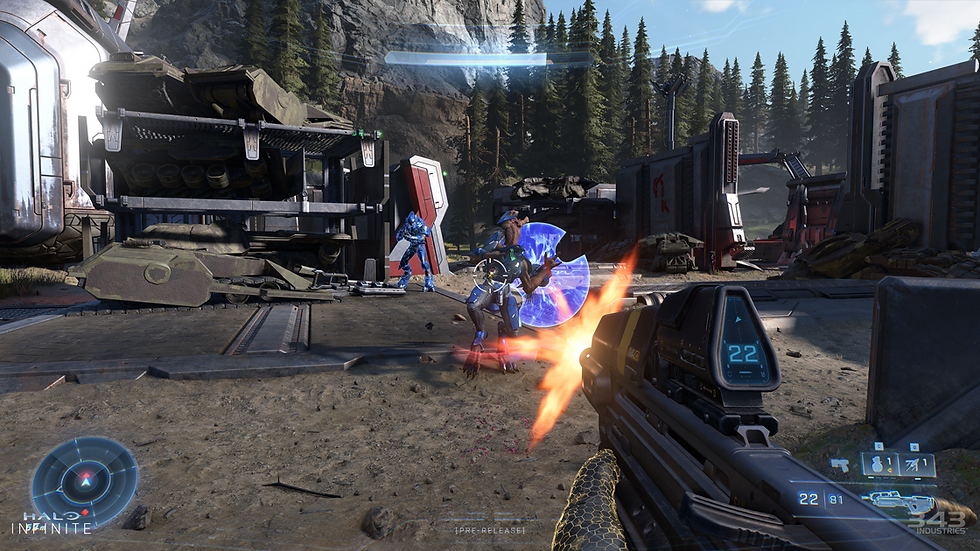
And for the following games 343 continued these developments. They didn’t introduce them; they were just following what Bungie did before. Homogenization of aesthetics and story? Bungie’s been doing that initially. Introduction of more mid-to-longe range weapons? Same. Loadouts in multiplayer? Reach did it first. It’s not to say that they didn’t introduce new good ideas or did good implementations of some previous ideas. I haven’t mentioned forge until now, but Halo 5’s and Infinite’s forges are direct improvement over what Bungie started. Their games are at worst, just ok.
Speaking of Halo: Infinite. While most games in the series after CE didn’t follow on these ideas, Infinite brings some of them back and actually improves on some elements. Enemy AI is as advanced as ever. The environment and object design returned to its roots just slightly modernized, though the game still has realistic high-fidelity graphics. The vehicle combat became more balanced thanks to new electric weapon type. And in general, Infinite has probably most mechanically rich arsenal in the series. New equipment is mostly useful and always available to players, though the grapple hook is a definite standout. It adds to mobility, allows us to get weapons from a distance or other objects like throwable barrels, close the distance with enemies, and even makes hijacking enemy vehicle or just getting into one much easier finally making vehicles feel like a part of overall combat. It honesty feels like a proper first next step for the series gameplaywise. There were some other QOL additions, but I obviously wasn’t perfect. Story was messy and bloated. Level design is too repetitive and simple. Same with environment. Open world a distracting idea. And while the sandbox is richer than ever, it has the most of the mid-to-longe range weapons in the series, which is especially worse in multiplayer. And multiplayer is a separate can of worms that I don’t want to discuss, and granted, it was discussed enough at this point. Most issues are related to rushed development and bad management both within the studio and outside of it. Cough cough, Microsoft, cough.
But, as a proper return to form, that being Halo: CE, Infinite lays down good groundwork to follow up. It will be followed up properly, right?
Called evolved, but I don’t really see it
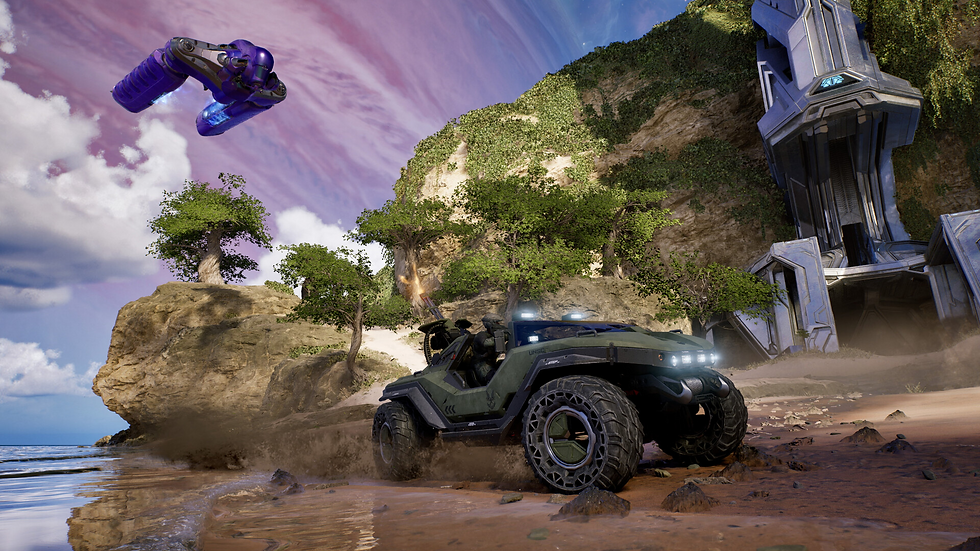
While I haven’t played Halo Campaign Evolved, remake of Halo: CE, I must be honest, not a fan of what I see. Aesthetics homogenized more than ever and modern lighting that I see in this game genuinely starts to give me a headache, which is rare. Story seems to be made more of generic military sci-fi. The level design seems to remain same, but I can’t confirm that at the moment. The saddest part is that sandbox seems to be regressed back to the times of original trilogy, ignoring all the innovations from Infinite. The frustrating part is that it follows the worst practice of the remake, by being to similar to the original game in most gameplay aspects. The frustrating fact is that the game will come with 3 extra prequel mission with seems to have new levels and environments, story, weapons and maybe even enemies. It is a good thing overall; I just wish the whole game was like that instead of being mostly repeating what came before.
It unfortunately continues to suffer from corporate involvement and makes it more generic compared to where it came from. Some elements of the series like two weapon slots or regenerating health, became a part of many shooters in 2000s and partially in 2010s, which made these mechanics seem generic and not deep, even though they were initially more complex. And unfortunately, it looks like the new game becomes the parody of its own series.
Sprawl Zero demo and future of the branch

The most regretful part about it is that the ideas of the series are interesting in concept, but for the past 20 years were mostly unexplored. Not until now.
Most people interested in game industry and its history have already noticed a phenomenon of returning game styles, both aesthetic and gameplay, in the past decade or so. Early 2010s brough back game style of 3rd generation of consoles. Late 2010s, 4th generation and early PC games, early 2020s 5th gen and late 90s PC games’ style and now entering new half of the decade we are seeing return of 6th gen and early 2000s PC game styles. One of the front-line games that brings it back, and most importantly, gives old ideas exploration they deserve, Sprawl Zero.
Recently released demo of Sprawl Zero feels like justice that these game elements of the series deserve. Aesthetically, it is influenced by late 90s – early 00s, and similar to Halo: CE, partially inspired by anime, most notably, Ghost in the Shell, which is mostly felt in environmental design and some elements in the music. In terms of story, it follows the idea of the military power fantasy but gives hints of the critiques of this structure and exploitation, reminding me Half-Life 2 mods – Entropy Zero 1&2. Speaking of Half-Life. Sprawl Zero in some respects is influenced by it and partially FEAR.
But most importantly, is that its gameplay, while heavily inspired by Half-Life 2 and FEAR, is mostly inspired by Halo. The game follows the idea of pickup-discard weapon playstyle and experimentation in combat by limiting weapon slots to one and not allowing players to pick up ammo form other guns, meaning, once you fire that clip, you’re done with the gun. Best you can do with it is throw it at someone. In addition to being able to pick up weapons from a distance it creates definitive version of this playstyle. Combined with FEAR’s slowdown time and Half-Life 2’s gravity pickup mechanics, along with some new mechanics like bullet reflective shield, creates combat with a great feel of being a fast tank and pushes to being active, by building the gameplay around arsenal of player abilities, as opposed to their weapon arsenal, which they don’t have.
Compared to Halo: Campaign Evolved, demo definitely made me excited for the upcoming Sprawl Zero and most importantly, gives me hope that great original ideas from first Halo game will finally get their appreciation and exploration that they deserved.


Comments