

About my experience working at Deep Rock Galactic
- The Deep Dive
- 6 minutes ago
- 57 min read


Recently I’ve hit over 700 hours on Deep Rock and promoted all my 4 dwarfs to platinum rank, both of which are big milestones. Reflecting on them, made me realize that Deep Rock became a big part of my “gaming routine” and that I really care for the game. And so, I decided to talk about it. Deep Rock Galactic in the populace is known as a funny coop horde FPS with dwarfs in space. Which is not inaccurate descriptor, but a shallow one, that doesn’t tell a full story about the game. And so in this review, I decided to “Dive Deeper” (check the name of the blog) into this game, to talk about it’s mechanics, structure and other elements, as well as for why I still after so many hours play this game, and, hopefully, give people a proper image of what the game is about and get them interested in the game. So, let’s begin.
You and your team
DRG (short for Deep Rock Galactic) is a coop shooter where you and up to 3 other dwarfs are send by the titular Deep Rock Galactic corporation to extract and maintain that extraction of the riches of the planet Hoxxes IV, the richest planet in the known part of space full of the most dangerous flora and fauna. You can play the game solo, but I want to focus on coop first.
The game features 4 classes, equal to the max team size: Engineer, Scout, Gunner and Driller. Each class is equipped with the following: Primary and secondary weapons, armor (though each class’s armor is the same aside from one resistance upgrade specific for each class), pickaxe, traversal tool, special tool, throwable and a few flares. Almost every piece of their equipment has upgrades, most notably primary and secondary weapons. They also have a few slots for active and passive perks. Before I talk about the main bulk of their arsenal I want to talk briefly about the perks since they are in my opinion the weakest part of the game. They are not bad, but they suffer from imbalance due to opportunity cost (some perks are always useful as opposed to some more situational ones), class preferences (some perks are not preferable on some classes, but must have on others), solo vs coop preferences (some perks are good for coop missions but practically useless in solo) and some being noob traps. I wouldn’t say all of this is bad or that there are horrible perks, but I just think that some perks in terms of overall balance were overlooked and I would like devs to look into them. Now this out of the way, let’s go back to classes.

Each class/dwarf could be placed on two scales: combat and utility scales (game doesn’t do this categorization, this is my categorization based on my experience). The placement on these scales is determined by traversal and special tools as well as their weapons, which determine overall role of the dwarf in the team. Each dwarf has one traversal tool, one special piece of equipment, three primary and three secondaries to choose from and 4 throwables to choose. All of them, except for throwables, as mentioned before, have their own upgrades. Weapons especially have 5 tiers/slots for upgrades as opposed to other equipment that has 2-4 slots. I addition to that, each weapon has one special slot for something called overclock, a special upgrade that more significantly alters the function of the weapon. They come in three variants: clean, which give only minor upsides but with no downsides, balanced, which give more moderate upsides for minor downsides, and unstable, which give significant upsides for almost just as big downside. It is in these upgrades and overclocks where most of the class playstyle variety lies, and I would like to talk about each class and their options in a bit more detail, as well as their team role, starting from least to most favorite class.
Engineer
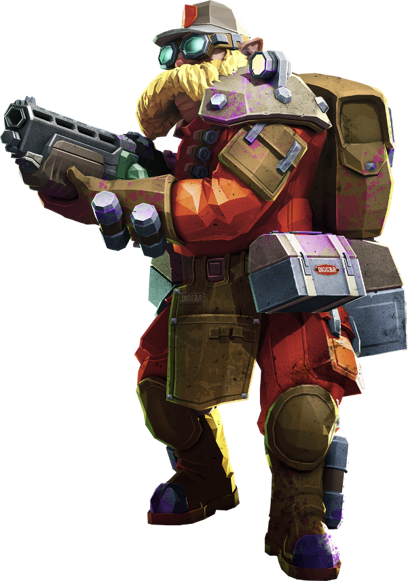
Starting with Engineer, he is the closest this game will get to a generalist class. Despite this, he still has a specific role to play. Combat wise, he specializes in crowd control, specifically in the more defensive form. His special equipment, sentry turret(s), provides fire support during combat, as well as providing a space to retreat to. However, they take some time to build and often require reloading, enforcing defensive playstyle on Engineer. His traversal tool, platform gun, makes him second highest utility member on the team. Not only does it allow him to provide platforms for himself and his team, but it also allows him to make simple constructions, like bigger platforms to extend space, roofs to defend from projectiles from above, or small pillars to give some high ground, fill different holes to prevent the teammates from falling and blocking the tunnels for enemies. In addition to this, it also has two important properties. First, platforms can negate a solid amount of fall damage, providing Engineer and his team quick and save option for decent. Second, it can slightly repel bugs, allowing Engineer to somewhat control movement of the bugs. All of this, make Engineer an important class for providing team support and helping with completing objectives.
As for his arsenal, this is where I think his weakness. Not to say that his weapons are bad or that he has no playstyle variety. He has all that and I like playing as him, I just think other classes provide more, hence why I like them more. His primary weapons are where the weakness lies in my opinion. "Warthog" Auto 210 Shotgun and "Stubby" Voltaic SMG are not bad weapons, on the contrary, they are the most consistent and reliable weapons in the game, and they also provide their own functional variety, like how shotgun can be used to burst fire turrets or SMG to electrocute platforms and turrets, it’s just other weapons, especially Engineer’s third primary, LOK-1 Smart Rifle are more complex and have more options. Most of Warthog’s and Stubby’s upgrade and overclock options are about accuracy, damage, ammo and rate of fire, among other things, and while there are extreme cases where the changes are significant, I find other weapons to be more interesting in comparison. I mean, LOK-1 alone is an example of this. Smart Rifle might be one of the most interesting weapons in FPS I’ve ever seen, due to its unique aiming mechanics, where instead of aiming at the enemy, the gun does it for you, but you need to readjust bullet trajectory, sometimes by even looking away from the enemies, making you learn new way of aiming and providing options to hit bugs at unconventional angles. And to top it all off, the DRG provides a solid list of options for customizing this gun, thanks to its complexity.
Engineer’s secondaries are in an interesting spot. For other three classes, secondaries are either a backup or a utility weapon that combos of the primaries. Engineer’s secondaries don’t do that, instead, they are his main source of damage and crowd control and are considered to be the strongest weapons in the game. Deepcore 40mm PGL is a grenade launcher, Breach Cutter creates a wall of plasma, and Shard Diffractor is a DEADLY LAZER. They similarly can have different functions depending on upgrades and overclocks. Grenade launcher could also be a single target beast or a rocket jumping weapon, Breach Cutter can apply different status effects or spin in more than one way, and Shard Diffractor can boil ground, explode platform, have wider area or EVEN BIGGER DEADLY LAZER. Overall, there are options for these, and they are really satisfying to use and experiment with.
Briefly about throwables. LURE grenade is a good distraction and is useful for crowd control but is a bit underwhelming. Plasma Burster is a solid “extra” explosive option with, in my opinion, neat learning curve. Proximity mine is a perfect defense option. And Shredder Swarm creates a small swarm of robot shredders that help Engineer to play more aggressively.
Overall, Engineer is a class with a strong identity, broad team role, and strong weapon options, but has the weakest build variety compared to other classes, but nothing particularly bad. Again, he is a good class, I just like him the least.
Scout

Here comes the poster boy of the DRG. If Engineer was somewhere in the middle of the class axis, Scout is on extremes of those. Quickly about his tool. Flare gun helps light up the caves. That’s what it does. It’s really nice and useful for being able to see shit but that’s all it does. It is annoying when new Scout players don’t use it though. Now Grappling Hook on the other hand is an insane traversal tool. If you played Dishonored 2, you will be reminded of Far Reach because that’s how it functions. It allows you to move in a straight line into the point that you are aiming at, as long as it’s in range of the hook. You can release the trigger mid flight to move based on momentum. You can keep holding the trigger even if you reach the destination, allowing you to infinitely hang on the surfaces, though you can’t do anything else. And the best part is that it has no ammo and is just on a short cooldown. The only downside is that teammates can’t directly benefit from it. It has a big skill ceiling and provides a lot of mobility that is useful for both combat and exploration. And speaking of which, Scout is teams dedicated explorer and resource collector as well as being the best at completing mission objectives. Thanks to both grappling hook and flair gun he’s the best at spotting any stationery treats in the cave, or any threats in general. And other treasures and local events. His movement allows him collect resources all over the cave at faster rate than any other class. Most notably, Nitra, a mineral that can be exchanged mid mission for a resupply pod that provides health and ammo, which is important because starting amount of ammo, which is max at a time, is almost never enough for mission completion. So having ammo reserve, especially on longer missions that require more than one resupply, is extremely important. Finally, most of the primary and secondary mission objectives are related to finding and/or collecting different materials or items. And those that don’t still require some amount of cave exploration for completion. This, in my opinion, makes Scout the highest utility class out of the four.
As for his weapons and combat – Scout struggles with crowds but performs best at dealing with big or special targets. Basically, he’s a pick class. Most of his weapons are either dealing a lot of precision damage, usually utilizing weak point bonuses, or dealing big burst damage. Meaning that there is a need to kill a big or special threat, Scout is the best one at doing it. Combined with his free mobility he’s really efficient at his job. However, on other side he’s bad at dealing with big groups of enemies. Well, if he’s surrendered. His grappling hook allows him to disengage from combat or aggro bugs away from the rest of the team.
His other weapons are related to crowd control, but mostly by slowing down enemies or applying status effects. Which makes him the slowest at dealing with groups compared to the rest of the team. However, Scout can play around with the mentioned status effects. He has a lot of options that buff other status effects or allow him to benefit from applying said status effects. He’s not a kind of said status effects though, but on that later. But he has a lot of options in terms of them and can combo reliably combo of them, especially in terms of his throwables.
In conclusion, Scout is important class in terms of utility and fills up a unique combat role for the team, and has a lot of options to play around, most of which have fairly high skill ceiling. The only reason why I prefer the other two classes is because they are more team oriented compared to Scout, but I would be lying if I said that Scout isn’t a blast to play.
Gunner
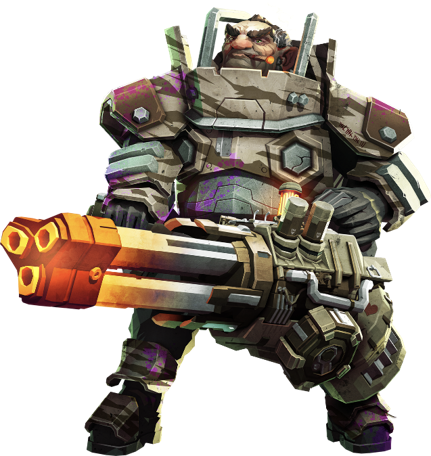
The big man. The heavy. The tank. The team anchor. Gunner is a dedicated combat class of the team being both consistent in crowd killing and single target elimination. Additionally, he provides a lot of support during combat. The only downside is that Gunner has almost no utility. This is the most reflected in his traversal tool – ziplines. Ziplines are situationally useful but they are really limited. They have few shots, they are slow on ascend, and you can be knocked out if you’re hit by projectiles. They are a reliable way to descent into caves, negate fall damage upon grabbing them and could be used to pick up heavy objects from the caves, but this is where it ends. Now his special equipment, Shield Generator, is another story. This might be the most class defining and important tools of this category among all classes. Not only this provides an reliable backup option for both Gunner and his team, but it could be used to open spaces from enemies, because shield forces bugs to go away, which is especially useful on big bugs, provides windows to pick up resupply mid combat, and most importantly, a safe way to revive teammates. For this reason, Gunner sort of feels like a team’s medic, reviving any downed teammates.
And as you might have noticed most of this is related to combat, so what can he do besides that. Gunner, as the name suggests, has a strong arsenal. As mentioned before, his primaries are strong for both single and multiple targets at a time. Of course, some options are better at one role than the other but in general they are consistent at both. Not as good as Engineer in crowd control or killing special targets like Scout, but he is a reliable second-best option. But two unique things about Gunner’s weapons and what really sets them apart are ammo efficiency and how long he can fire his weapons. Minigun, for example, by default has 2100 rounds, and that without ammo upgrades, and, theoretically, can fire without a break, as long as it doesn’t overheat, which isn’t particularly hard. For these reason Gunner is a reliable tank because he can reliably provide support to his teammates when they have downtime or add pressure to the swarm, as well as being the most likely class to share their resupply, due to the sheer amount of ammo at the start. As for his secondaries, they mostly act as back up weapons but can also be used as extra power options for single targets, additional crowd damage or combo weapons when built into fire. In a similar way, his throwables are just different types of grenades, adding CC (crowd control) options.
Overall, he doesn’t provide much help during exploration or with objective not requiring fighting, but when bugs are coming, he is a strong dwarf that his team can rally around and he is the most consistent class, when it comes to fighting bugs.
Driller

And now, we come to my favorite dwarf. In my opinion, Driller IS the DRG class. Unlike the other 3, which could be moved to other shooters in one form or another and feel relatively fine, Driller can work only in DRG. In a world made of distractable terrain, Driller becomes an artist. The cave is your canvas. Your drills are your brushes. They allow you to create tunnels connecting two points in a straight line, free up territory, remove obstacles, relocate objectives by drilling underneath them, and in general provide a lot of movement. And while they run on fuel, the game is incredibly generous with it, so it will take a while before you need to refuel them. And if that wasn’t enough, they could be used as a weapon and under certain builds, specifically related to Cryo Cannon and Vampire perk, can provide a stable source of health. Because of these mechanics specifically designed to interact with the environment in DRG, Driller can’t be moved to other FPS without hurting his identity. His special tool, Satchel Charge, aka C4, is a huge bomb that can be used against a big group of enemies, it can also destroy terrain, making it a great addition to drills on the matters of terraforming.
In turns of his weapons, Driller is quite unique. Pure cruelty of his arsenal aside (this dwarf made a microwave gun that gives cancer, this man is evil), it requires a bit more thought. The main function of his primaries is to apply different status effects, those being fire for damage over time, freeze to stop bugs and triple incoming damage on them, and acid to slowdown movement and eat armor, and unlike most of the Scout weapons, this is their primary function, damage is secondary. For this reason, the way you use them is by applying the status effect on one group of bugs and leaving them in search of another group to make miserable. Not only this allows Driller to cover more targets at a time, though it would mean that it would take him some time to deal with these targets, but on a flip side, he provides a lot of support to other CC oriented classes by providing additional damage, boosting their damage, or making swarms easier to manage. Add different overclocks into the mix that allow more ways to apply these effects, like Sticky Flames or Snowball, boost certain stats, like Tuned Cooler, or introduces new function, like Combustive Goo Mix, which makes burning enemies covered in acid or enemies covered in acid set on fire explode in a big chain reaction.
And if that wasn't enough, Driller also got interesting secondaries. Well, two interesting secondaries. Subata 120 is just a pistol. Like, the most normal pistol out there. However, the other two secondaries are anything but simple. Experimental Plasma Charger, aka EPC, can be a reliable backup weapon, especially thanks to its two different firing modes. But it has a few interesting options. One upgrade allows applying fire, which work with all weapons: with flamethrower helps applying fire effect, with Cryo Cannon allows dealing temperature shock, damaging effect when fire or freeze override each other on one target, or for Sludge Pump it allows different functions like already mentioned Combustive Goo Mix. But most notable upgrade for this gun is Thin Containment Field. With this upgrade, when you hit charged shot with a normal shot, it will explode with more radius and more damage than regular charged shot. This mechanic provides plenty of additional CC, while also requiring unique skill to pull off. In addition to that, I can also destroy terrain, which enables EPC to be used for terraforming, but mostly for mining minerals in tricky spots. As for the last secondary, Colette Wave Cooker, it doesn’t deal much damage, but it combos well with other primaries by doing different effect like applying temperature shock with only fire or freeze required, making enemies explode on death, and with different overclocks, creating more weak points on enemies or applying radiation. Overall, the main purpose of Drillers secondaries is to provide unique utility or directly interact with his status effects in a lot of emergent ways.
For these reasons, his unconventional arsenal and terraforming abilities, Driller is the most uniquely specialized class, as well as my favorite.
We fight together
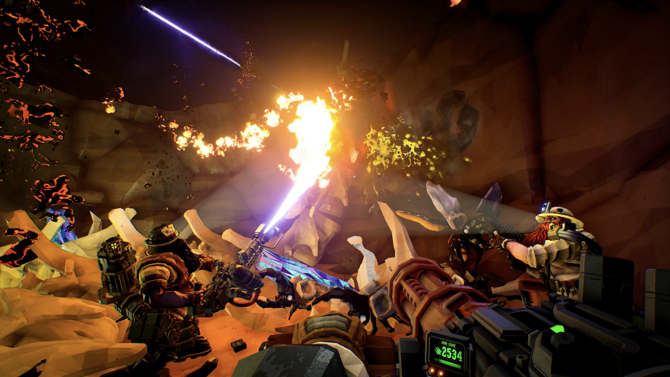
After explaining about different class roles and complexities, let’s talk about how they work together and why they work together and encourage cooperation. We’ll discuss this in other sections, but DRG provides a wide variety of objective and enemy encounters to incentivize having a team with all 4 classes and make them work together.
Let’s start with combat. As mentioned previously, Engineer can deal with a bug group of enemies quick but suffers from big downtime between usage of secondaries. Gunner on the other hand, can do continuous fire, which perfectly covers Engineer’s weakness and gives him opportunity to reload. On the flipside, Gunner if not careful can be easily overrun by bugs, something that Engineer can help him with his burst AOE damage. Basically, they cover each other’s weaknesses. But they also have a strong synergy. Engineer’s turrets and his general defensive playstyle mix greatly with Gunner’s tank approach and shield generators, making them a perfect defense duo. In addition to that, Driller, as mentioned previously, can provide different types of support, and works especially well with Gunner, who can somewhat reliably set enemies on fire, providing more synergy. And finally, Scout, who depends on this CC of his team the most, fills the gap of a pick class and assists his team needs to deal with dangerous threats. Scout also works great with Driller due to their gameplay often rotating around status effects and Gunner due to both classes being good at dealing with big threats. There are more ways these classes benefit from each other during combat, but the main point is that they work as one group and when one team member isn’t doing their job, it’s felt on the rest of the team.
As for mission objectives, there are synergies as well. Most notable one, Engineer and Driller. Unsurprisingly, a class that can create terrain and a class that can destroy it are great at terraforming environment to fit the needs of the team. Engineer also works great with Scout. Scout can get anywhere in the cave, but it doesn’t mean that he can stand on every wall, which makes it harder to mine minerals. But this problem disappears the moment Engineer places his platforms next to these minerals. Scout can also team up with Driller. One can explore large caves, another creates direct lines between these caves without the need to use the long way, which helps greatly on missions that require searching non-linear caves. Lastly, while Gunner’s ziplines aren’t the best for solo traversal, they are still great addition to team’s arsenal and fill the needed gaps with movement and utility of other dwarfs.
So, on both combat and utility side of the spectrum, all 4 classes have a strong overlaps and synergies that greatly benefit each other and encourage cooperation. This is of course not the only way the game encourages cooperation. For example, in most mission types of dwarfs are joined by Molly, a robot-minecart that stores minerals and other resources collected by the team. All dwarfs have a limited inventory size, even with upgrades related to that, so fairly often they have to deposit their stuff into Molly. The thing is, Molly is pretty slow, meaning that if the team is spread out, everyone will have to wait sometime before they can deposit. This is not the issue, however, if the team sticks together and keeps Molly in close proximity to each dwarf. And this is a great way to subtly keep the team together, because it mostly punishes players going away from the team: if one player is away, they will have to wait for her more often then the other three teammates that stick together, because Molly needs to be called and three players call her more often than one player, keeping her with the main group. There are other subtle things that encourage players to stick together. Resupply pods have exactly 4 resupplies, 1 for each member. Any building/repairing work is done faster if more dwarfs are working on the same things. Usually to activate special events, 4 buttons need to be pressed. And some objectives are done much faster if all four players are doing it at the same time.
Basically, there are direct and subtle incentives for cooperation, and thanks to each class having dedicated role and being mechanically complex, most of the game’s lobbies teams consist of all 4 classes working together. Lastly, I want to point out how this cooperation, despite all incentives, doesn’t feel forced. While indeed, all dwarfs have their own roles, they are not always forced to do it. Just because Scout is the best at mining, doesn’t mean that other dwarfs can’t mine to. And same goes for combat and exploration. Each class isn’t always reliant on other class to able to do something. For this reason, solo play is possible and class stacking situationally can be good. But even developers understood that while it is possible to do mission solo, they still give players Bosco, a drone acting as a substitute for the rest of the team. In other words, classes are designed to work together and benefit from each other, but they have enough independence to have more diverse play and leave frustration that may come if your teammates don’t always do their job. I’d argue that this is one of the better ways to implement coop in game like this.
Attention team, swarm incoming

Now, let’s talk about the threats of Hoxxes IV. The bugs. Out of all horde shooters that I’ve played (granted that’s not a lot) DRG has the best bestiary that I’ve seen. They provide a consistent threat on different missions, have diverse types and test different skills.
Let’s start with the base of each swarm. The humble Glyphids. First, the simple grunts that provide the meat of every swarm. Individually they are weak but are strong in groups and can easily overrun an uncareful player. According to 2024’s official players statistics, glyphid grunts where the top second cause of death outdone only by
Checks the notes
Fall damage?
Continues reading
32 million deaths versus 17 million, almost two times as much, damn. And the third top…
Checks again
Friendly fire!?! What the fu…
Anyway, grunts also come in different variations: Slashers and Guards. They provide micro prioritization for simple swarms. Then there are Swarmers, smaller grunt siblings that are harder to hit and present threat to classes that require precision. They are every Scout’s bane of existence. Lastly, the Praetorian, a big older green brother of grunts, that acts as a tank of the swarm and requires repositioning to hit his weak point on the back, precision to hit his face that acts as alternative weak point, or heavy power to strip his armor. They can bite, spray acid and leave toxic cloud upon death. They provide additional pressure and act as a soft counter for less mobile and more CC oriented classes, mostly Engineer and Driller. Not to say that they can’t deal with praetorians, on the contrary, they got options, they’re just not as good at dealing with them as Scout or Gunner.
These create the base of every swarm and as you might have noticed, test each team member and their ability to fight together. However, if this was it, it would be a really repetitive game. But thankfully, there are more bugs. I call these, support/special bugs. Firstly, there are the ones that shoot all sorts of projectiles and have all sorts of behaviors. Acid spitters can crawl on walls and ceilings and shoot single shots at a time. Then there are Septic Spreader that are grounded and can cover small territory with their acids. Then there is Menace that shoots in bursts and burrows to reposition. Barrage Infectors, stationary tree like organism, that shoot a burst of explosives. And many more. These test ability to pay attention to your surroundings, precision and ability to focus fire, depending on threat.
Then there are enemies that test your ability to pay attention to your surroundings like Exploders, Stalkers, Grabbers, Leaches and many more. High-priority bugs like Wardens that give defense boosts to nearby bugs. Enemies that spawn enemies like Breeders or Brood Nexus. Heavy enemies like Stingtails or Oppressors. Flying Macteras that are harder to hit. And many more all of these require clever coordination, ability to prioritize and apply different behaviors to avoid dying. Best part is that there are plenty of ways you can deal with them. Macteras for example, can be killed regularly by just doing damage, but they also have weak points, rewarding precision, group together, rewarding AOE builds, and instantly die if frozen. Basically, they require unique approaches but provide enough options to maintain emergent gameplay.
Lastly, there are big threats and bosses. Bulk Detonator, for starter, might be my favorite enemy in the game. They are big tanky explosive bugs that can one-shot any dwarf withing it’s explosive range. The moment one spawns in the cave, the dynamic of the whole fight shifts and now there is a bigger threat that needs to be dealt. There are also all sorts of bosses like Dreadnoughts, Caretaker, BET-C and other mission related or just random encounter bosses that have their own unique strategies for how to deal with them.
Not to say that there aren’t a few stinkers in this line up. Rival drones and Rockpox infected bugs, enemies that are related to previous season events, have one major issue. Unlike previously mentioned enemies, that had preferred strategies but don’t fully force them on players, these have such strong resistances and weaknesses that they practically force specific builds one how to deal with them, making them the least fun enemies to fight. Not to say that they are horrible. They still have their unique behaviors and test specific skills, and they are much rarer compared to most enemies, they still remain the weakest part of the bestiary.
Overall, DRG has a really strong set of enemies, that provide enough variety, test different skills, and encourage experimentation with your arsenal, as well as pushing towards teamwork, which are even more noticeable on higher difficulties, which is a testament to good encounter and balance design.
Caves, jobs and other problems

We’ve now talked about dwarfs and their enemies. But where do they work and what do they do?
Let’s first talk about cave biomes. There is a total of 11 biomes in the game. They can range from pretty standard Crystalline Caverns to toxic Fungus Bogs to hellish Magma Core. Firstly, they differ in toughness of the terrain, generally taking two hits to break with a pickaxe, with some outliers like Magma Core taking 3 or Sandblasted Corridors taking 1. Besides that, terrain can vary in its patterns. While caves can come in different varieties, there is some consistency in caves of the same biome, mostly featuring similar shapes or structures related to the biome. For example, Hollow Bough, a region covered in dried wood, has a lot of rootlike structures covering its caves. As another example, Glacial Strata is full of spiky icicles covering floor and ceiling of the caves. All of these differences, in addition to an already robust base cave generation, provide diverse sets of environmental obstacles to move or work around. In addition to that, each biome also features unique environmental obstacles or other interactable objects. For example, Radioactive Exclusion Zone, as the name suggests, features crystals that emit radiation or Salt Pit that features breakable stalactites that could be used against enemies. Lastly, some regions can feature unique variant of some of the enemies, like how aforementioned Radioactive Exclusion Zone has radioactive variant of Praetorians and exploder, or completely unique, biome specific enemies, like Ossuary Depths being a home for scarab-like bugs, which can also add some variety to the combat. And now that we’ve answered the question of where the dwarfs work, let’s discuss what their work is.

The game features 10 mission types. Mission types are the primary objective that you will be completing, well, during the mission. They can vary from collecting certain resources or items like Mining Expedition or Point Extraction. They can also be combat oriented like Egg Hunt where you collect eggs and fight swarms of bugs, Elimination, where you fight Dreadnought bosses. They can also be about exploration, like Deep Scan or Heavy Extraction. Some mission types can have multiple stages, like how Salvage Operation asks you to repair a certain amount of mini mules (like Molly) and then defend two objectives, or Escort Duty where you first guard automated mining vehicle, aka Drilldozer, aka Doretta, aka Dotty, on it’s way to main objective, periodically refueling it and then defend it again but now also defending from the attacks of the sentient rock. And some are completely different, like On-Site Refinery, which asks dwarf to build pipelines to extract what is basically oil. Besides all this, each mission can have different pace based on random Cave Complexity parameter and number of primary objectives based on Mission Length parameter. In addition to that, each mission type has its own cave type to accommodate its structure. Mining Expedition is generally linear corridor that sometimes opens up into a bigger cave, Heavy Extraction and Deep Skan feature labyrinthian systems of tunnels and Elimination missions feature big open arenas. This makes general mission structure much more diverse and allows the game to present dwarfs with wide variety of challenges, in addition to diverse bestiary and biomes. To be fair, not all mission types are created equal. Industrial Sabotage is a common least favorite mission type due to featuring that mentioned annoying Rival Drones and having a pretty set structure. The criticism about a set structure can also be applied to some mission types as well, like Deep Scan or Salvage Operation. Finally, some mission types may not provide enough variety, like Elimination featuring only 3 Dreadnought types, or Escort Duty and Industrial Sabotage featuring the same boss by the end, which can get tiring at some point. These negative factors can sometimes undermine the existing emergent variety. Despite that, all these elements provide a lot of replicability and push for experimentation.
However, these are not the only ways in which the game can mix things up. During the mission, the game can generate additional rare encounters and mini-bosses, like Nemesis robot or Korlok Tyrant-Weed shooting plant, seasonal events like Rival Communication Routers that need to be hacked, Lithophage Meteorite that need to be cracked, machine events, timed encounters that usually require a lot of coordination to complete in time. They push the team towards improvisation and adapting to new threats and challenges, and they can appear on any biome and any mission type.
But wait! There is more!!! Missions can have Anomalies (positive modifiers) and Warnings (negative modifiers). They can vary from simple ones like Double XP or Exploder Infestation, to more game changing ones, like Low Gravity, self-explanatory, Blood Sugar, dwarfs take damage over time but all enemies drop health on kill, Low Oxygen, also self-explanatory, requires dwarfs to stick with Molly or other buildings that disperse Oxygen or, my personal favorite, Haunted Cave, which features immortal bulk detonator for the duration of the whole mission.

And all of these great systems: biomes, mission types, cave generation variation, different events and mutators, beautifully come together in Deep Dives. Deep Dive is a special mission that updates once a week, and comes in two variants: Regular, and harder Elite. Deep Dives are made out of 3 missions, where instead of regular secondary objectives, which are usually something like collect flowers or exterminate certain number of fleas, are instead smaller variants of main missions and are now mandatory for progression to the next stage. Additionally, they generally feature some amount of mutators and maybe some random event. And to top it all off, you get no ammo or health restocked between each stage, meaning that you need to manage your nitra between each mission, making it an interesting resource management challenge. All these factors make Deep Dives, especially the Elite ones, the ultimate test of players’ skills and teamwork. A Deep Dive with the bad team is a slow death. With the right one, it's a great performance of mastery of the game and coordination.
Now, we’ve finally covered the main gameplay structure of the game. It’s classes and their gameplay, enemies, environments, obstacles and objectives. The question that follows is: What is the reward for this work?
We are rich!!!
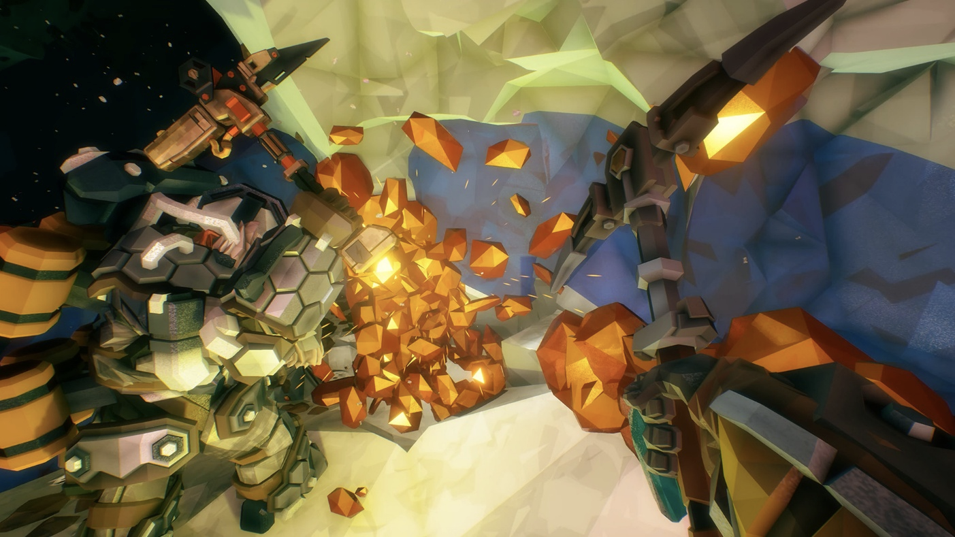
So, let’s address an elephant in the room. DRG is a modern game and includes the modern demand in multiplayer games for progression. The current expectation is to have some sort of progression systema and rewards related to it. And DRG is no exception. Deep Rock Galactic is a game about grind, but it isn’t an inherently bad thing.
First, let’s talk about how it’s structured. There are two main resource types to mine/find in the caves: Gold and materials. Gold is self-explanatory, it’s a currency. It spawns in any mission and Deep Dive, you also receive it for completion of each mission and sometimes for good performance, like making sure that the whole team is back from the mission. Materials are a little bit trickier. There are 6 different materials, and unlike gold, it can only be mined from the caves, and you don’t receive it as bonus for completing missions and they don’t spawn in Deep Dives. That’s some limitations, but on top of that the game only generates two material types per mission based on a biome that the mission is taking place. Meaning that rate at which you collect them is much slower than gold and also pushes players to play on different biomes. You can exchange minerals at the mineral exchange, but you don’t exchange it at 1:1 rate, so playing on more biomes is better. Gold and minerals are exchanged for basically everything in the game: weapons, weapon upgrades, cosmetics and overclocks. The only thing that doesn’t require them to buy is beer at the bar, which just requires different ingredients that you can find on a mission. But back to buying stuff. This can be overwhelming for new players on what to do and how to manage where to play to ensure that players get everything they need. Meet assignments.
Assignments are the primary means for progression. Each assignment is a set of 3-6 missions that require specific mission types and biomes. They unlock weapons, cosmetics, difficulties, and promotions. But players don't have access to all assignments at once, they're gated by two levels: Player Level and Class Levels. Player level aside from unlocking some cosmetics, most of the cosmetics are bought at the cosmetic store for gold and materials, assignments are usually just the means to keep track of players’ skill levels. Now class levels are much more involved. In the beginning of the game, players have access only to one primary and secondary weapon and one throwable. Weapons, along with all other equipment, don’t have any upgrades unlocked. The way players unlock them is by leveling up the selected dwarf, which unlocks specific tier of upgrades on different pieces of equipment, and then by with gold and materials. This ensures that you understand the fundamental functioning of each tool before you can customize them. Ok, but how do we unlock the rest of the weapons? Throwables can just be bought, but weapons? First, you need to reach a specific class level, which gives access to an assignment that unlocks the specific weapon and after completing the assignment you buy the weapon. Similar to upgrades, this is done so that players get fully accustomed to using the current weapons before they could move to the next one. So, through promotions and levels the game keeps track of what players are doing and making sure that they understand how individual systems work as well as varied sets of mission and visible milestones.
Once the dwarf reaches level 25, they unlock the promotion assignment. After completing the assignment and paying for promotion, dwarf’s level is reset and they get a rank that now levels up each promotion. Promotion is perhaps the most important milestone for the player. First, it grants access to Deep Dives, basically saying that you’ve proven your skills and you can handle a harder challenge. But only for the promoted dwarf, so if you want to play Deep Dives with different classes, you first need to prove that you can play them too. And secondly, and most importantly, grants access to matrix core system. There are 3 types of matrix cores: blank cores, overclocks and cosmetic cores. You get these by promoting, completing weekly core hunt assignments and completing Deep Dives. Overclocks and cosmetic cores can be crafted at the forge for gold and minerals, functionally the same as buying, but at the higher price. For every 5 crafter cores the game gives you one free core. As for blank cores, remember the machine events, the timed challenges that can spawn on missions? After completing one event like this, you’re able to exchange one black core for a weapon or cosmetic core at your choice.

This all may sound overwhelming, because at first it is. Cores present the player with an “endgame” for hundreds of hours. So, the game doesn’t introduce you to the system until you’re accustomed to the game. You can’t even activate machine events unless you are promoted at least once. But the big question is, does this all work? Well, mostly.
Everything that I’ve said about assignments, weapons, upgrades and regular cosmetics works. You know what you need to do, you have consistent rate of getting access to things, and most importantly, you know what you get and can choose what you get. Core system is less flexible. If you pay attention to all way, you get cores, you realize that there is a capped unlock rate. Core Hunt assignments and Deep Dives can only be done once per week. Well, Deep Dives can be done multiple times, but there is no reason too – not only you can’t get new rewards, but the Deep Dives are also exactly the same, down to cave generation. Once you’re done with them for the week, you have to wait for the next week for them to get updated. And promotions are even rarer. This all makes core hunting not particularly a fast thing to do. For overclocks, I think this is a good thing because you get time to play around with the new overclock before you try the next one. But there are a few caveats. Most notably is that you don’t know what you get. Yes, you have some choice when completing machine events, if you want overclocks instead of cosmetics, you can choose to get them. But overclock for which class and weapon? It’s completely random. If you main one class, this sucks because sometimes you just don’t get a choice of your class. If you main all classes, like me, this is not an issue but there are other problems. Because you level up all 4 classes, this means that you at the same time unlock things for other classes, but most likely you haven’t unlocked everything. So, you choose to get an overclock, you select a class that you play… and you get an overclock for a weapon that you don’t have yet. So, it’s sitting in your forge until you unlock the gun for it. These things can be annoying, but in retrospect? It’s fine. If you’re new player that just got promotion, all these nuances are annoying. But at higher levels, you get more weapons, upgrades, overclocks, and if you play on higher difficulties, you earn more gold and materials, and this grind smooths out and becomes… rewarding. You get more toys to play with, your general strength and skill have increased, and you kinda stop caring about what you get, you can have fun with it anyway. And as I said previously, the rate you get them is fairly reasonable. The only reason why is unlocking all overclocks may take a lot of time is because THERE IS SO MANY OF THEM. 40~ per class. Almost 160 of them. That’s a lot!

Lastly, there is one more progression system to talk about. Season passes. A lot of people reading this have had a heart attack. “FOMO?” some will ask. Thankfully no. So here is how seasons work. You have a main pass, by progressing in it you get materials, gold, cosmetics and scrips. You can also get scrips by completing events or missions with mutators related to each season, but I’ve talked about them before, so let’s move on. Scrips can be used to unlock cosmetics and resources at cosmetic tree, another progression element that comes with each season. Why is this system good. First, you have access to all season passes and you can complete any of them at any rate you want. So, no FOMO. Secondly, all of them are free. You’ve already bought the game, have fun. The best part is that you mostly progress through it passively, so you can still do any assignments you want and progress through the pass, and the resources that you get from it can be used for other unlocks. This is a good system, my only problem with it is that in season 3 rate at which you get events to get scrips is slower than others, and that’s it.
So, there is a lot to DRG progression, and to be completely honest, it is a grind, but a fun one. The game itself is still fun, and these grind systems are mostly happening in the background, so you don’t have to do anything external to get all this stuff. But the best part is that it feels rewarding. You constantly get new things and when you unlock weapons and overclocks, it feels like you’re becoming stronger, partially because you spend time with these tools and get better at them, because the game makes sure that you do. And this feels great, even if initially it feels daunting.
Before we wrap up progression and talk about more interesting things, a few words on cosmetics. They are great. Really great. Firstly, there are a lot of them. They are varied and help more experienced players develop their dwarfs’ own identities. Secondly, there are many ways you can get, besides store, cores and passes, you also can get random drops during the missions with lost equipment and crates. And finally, there are cosmetic options for practically everything, dwarfs, weapon paintjobs and frameworks, pickaxe cosmetics. You can even customize our friend Bosco. You have lots and lots of customization options. Granted, there are DLC cosmetics, but they are reasonably priced, and you never feel pushed to buy them, mostly because they make up less than 10% of all available options, so you have plenty of things to play around. To wrap this section because we talk about other good-looking parts of this game, I want to share some of my favorite dwarf drips that I was able to make in my time. Enjoy!


Danger. Darkness. Dwarves.

Let’s move on from nerd stuff like progression and talk about fun stuff, like aesthetics. DRG is a really pretty and, more importantly, distinct looking game. It has an interesting thing, where the models and environment have a lot of details design wise, but the textures mostly feature one color and models themselves are made out of noticeable polygons. The thing that helps the game not look flat with models like that is the lighting and different modern effects. This gives the game this neo-retro style to it. So much so that if you reduce resolution scaling and make the image sharp (something that I do for better performance), it will fit with the existing style pretty well. And since I’ve mentioned, don’t let my description of my graphics settings give you a wrong image – Deep Rock is a really well optimized game, so much so that it only weights slightly above 3 GB. My system is just really weak. For a game with such complex destructible terrain system, which is in part achieved by the simple visuals, this is really impressive.

But let’s go back to visuals. DRG might be one of the best games to utilize color for its gameplay. For stater, the enemies have color gradation. This really helps to differentiate each enemy from the crowd. Grunts have normal brown color to prevent more colorful special enemies from blending in. Grunts have pretty simple designs, which makes sense for their role. Now let’s talk about more specialized bugs. Let’s use Mactera Spawn as example. First, similarly, to grunts it has a shell, but unlike grunts it’s a different darker color. And if that wasn’t enough to spot them from a distance, you definitely can spot their glowing neon yellow weak point. And this applies to all specialized enemies. Of course, you can spot different bugs by just looking at them since they have different outlines, but in the center of the combat you need to know where each enemy is and color is one of the best and fastest ways to do it. Additionally, the game does use the same colors as enemies for the terrain to prevent them from blending in with the environment.
As for designs of enemies, I love them. Firstly, they are fairly detailed and well animated. You can see all different limbs and how they move. Bugs can sometimes have some visual behaviors, like how grunts will raise their front limbs and screech as they approach you. My favorite detail is armor/shells, or rather how it breaks apart. Not only does it serve mechanical purpose, because armor is an actual mechanic and it informs you about damage that you do to the enemies, but also makes the enemies feel more visually layered. Secondly, the enemies are designed in relation to each other. One of the popular activities in the community is to create a family tree of all creatures of Hoxxes IV, and the reason why is because they are designed around that.
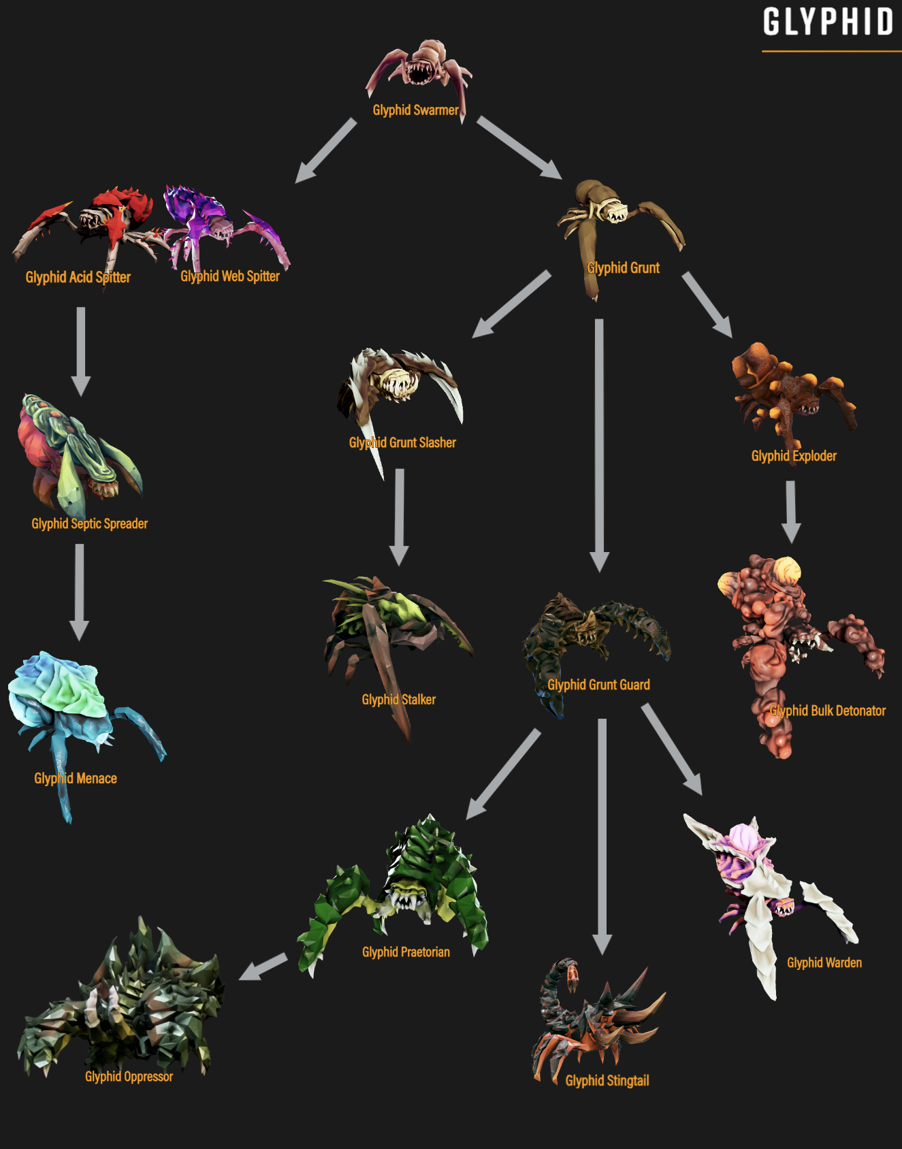
Going back to the caves. The environment design is great. As I already mentioned in one of the previous sections, each biome has different terrain patterns and color scheme. But in addition to that they also have a lot of different elements of the environment that add to the feel of the area. For example, Dense Biozone is covered with a bunch of colorful corals and features a wide variety of different plants.

In contrast, Radioactive Exclusion Zone is mostly grey minus the green glowing uranium crystals, and in terms of life it’s mostly sterile minus some mutated life forms that adapted to the area like breathing plants (with mouths) or a wall colony of eyeballs.

In general, enemy and environment design as well as cave generation convey the atmosphere of Hoxxes IV as a planet of enormous size with many different cave systems of varied shapes and sizes filled with life and diverse ecosystem that all feel believable.
The atmosphere of the game and the feeling of Hoxxes IV being bigger than the player is made stronger by sound design and soundtrack. Different terrain types make different sounds when you walk or mine them. For example, Fungus Bogs, a wet swamp, is mostly covered in dirt and soil, and it sounds accordingly. Sandblasted Corridors sound like sand, Glacial Strata sounds like ice, and Hollow Bough sounds like dried trees. This also applies to different resources that you mine. Gold is metal, so it sounds hard. Dense minerals like Magnite or Bismore sound a little softer but are still hard. Nitra or Umanite are crystals, so they sound similar to something like glass. Biomes also feature sounds related to other environmental occurrences. Like how different small or big eruptions in Magma Core at first make sounds of smoke coming out at high pressure before being followed up by fire.
There are many different sounds made for glyphids. A lot of them are designed to let the player know of the fact of incoming bugs and each bug has its own sounds to let the player know where each enemy is without needing to see them. So enemies like stalkers and grabbers are specifically test players’ abilities to pay attention to sounds because they attack from behind, outside of players’ line of sight. Sound can also be used to inform the players about the level of danger of different threats. Swarmer and grunts have pretty weak sounds, mostly to just inform players about their presence. Others like Septic Spreader or Stingtail make quick and sharp noises to let the players know about higher level threats and warn about incoming ranged attacks. The strongest and booming voices are given to the most dangerous creatures of Hoxxes – Oppressors and especially Bulk Detonators. The layered voice informing about the size of the creature, the notes of something boiling in its roars tell about its volatility, but also some hard breathing, implying the difficult existence of the creature.
Lastly, there are weapons and sounds of other dwarven equipment and machinery. Guns sound great. They have strong impact, they change sound pitch depending on number of bullets in a magazine or building up heat, and reload with strong, pronounced sounds. Other equipment of dwarves has a lot of industrial elements in its sounds: sounds go one after another, they are noticeably mechanical and reinforced. Other machinery follows this pattern. They feel reinforced, like how each of Molly’s steps go deep into rocks, which is appropriate since she can walk on walls and ceilings. Drills of different kinds sound fast and confident, showing how strong they are. And in general, some machinery like Drilldozer or Drillevator have a lot of sounds showing their diesel nature – shaking engines and loud exhaust pipes. My favorite is definitely Liquid Morkite Refinary, specifically on the last stage of the mission when it pumps out and refines the oil. The loud sound of a big pump, tough chambers releasing waste made through the process and of course aforementioned sound of diesel engines create this feeling of this industrial monster that extracts everything from beneath the surface. My last favorite detail about the equipment is how you can see its state without needing to look at UI. Most weapons have ammo counts on them and if they can overheat, they have indicators for that as well. Different machinery like Drilldozer or pipes for refinery that can be damaged show that damage visually and you can see it being repaired step by step.
Sounds are also accompanied by a great soundtrack. They mostly come in three variants: for exploring, for combat, and for escape sequences. The tracks that play during exploration or between combat can come in different flavors – they can be softly oppressive, warning about the dangers that can come, they can have industrial motives, reminding about the routine work that dwarves have to do, and, my favorite, solitary and isolated tracks that make you feel how small you are inside of this giant planet, but also about how you are alone opposed to the live inside of it. Combat tracks are more consistent in this regard. They still come in different forms, some are slower or faster, rock or soft electronic, but all of them do one thing – they make you feel pressured and surrounded. After completing each mission, you call the drop pod and start the final escape sequences. And all tracks that are played during this section convey an incredible feel of last second triumph and sense of accomplishment.
To wrap up the talk about great audio work that enhances the game feel and atmosphere, I want to talk about voice acting. The game features only two voices. One for playable dwarves and one for Mission Control (MC). Despite having same voice actor, each class sounds differently thanks to different sound pitch. Scout has high pitch, which conveys his high energy and speed, as opposed to deeper and lower voice of Driller making him sound tougher and more grounded. MC has a different voice to contrast him with other dwarves, while they are playful and hyped up, he’s really bored and exhausted. But this is more about their characters, which will talk about in a bit.

I’ve mentioned all of these visual and audio elements to explain the enormous work that the developers did to enhance the experience of the game, and most importantly, the immersion. Nowadays, immersion by some people is considered an overused term when it comes to game description. This is mostly due to how widespread it is and how people apply it to a lot of things. This is a separate discussion to be saved for later. As for me, as an immersive sim fan, it means a few things, mainly consistency between story and gameplay. Gameplay doesn’t contradict the elements established by the story and setting, and environment and other elements of the world can partially exist without a player. And in my opinion Deep Rock does a really good job at it. The best way to start in my opinion is the space rig. This place is important for multiple reasons, mostly because it replaces the main menu. When you boot up the game it greets you with a simple title screen, followed by an info screen where you can learn about different events and products related to DRG and a mod manager (and even then this screen can be turned off) and after that your in the game. No menu for selecting the game or joining a lobby or just classic menu in general. All of these are part of the space rig. Mission selection is implemented as a terminal with the hologram of the planet. Loadout selection is done through workbench. Cosmetic selection from the wardrobe. And other “menu options” like assignments, core forge, season pass and etc. have their own terminals that are designed for their role and incorporated into the environment. Workbench is surrounded by instruments, tools and other electronics that need to be fixed. Core forge is an actual forge with a furnace and anvil. So on and so on. By incorporating these elements that could’ve been UI options, developers instead opted for making them part of the world, making the player feel like part of it right away.
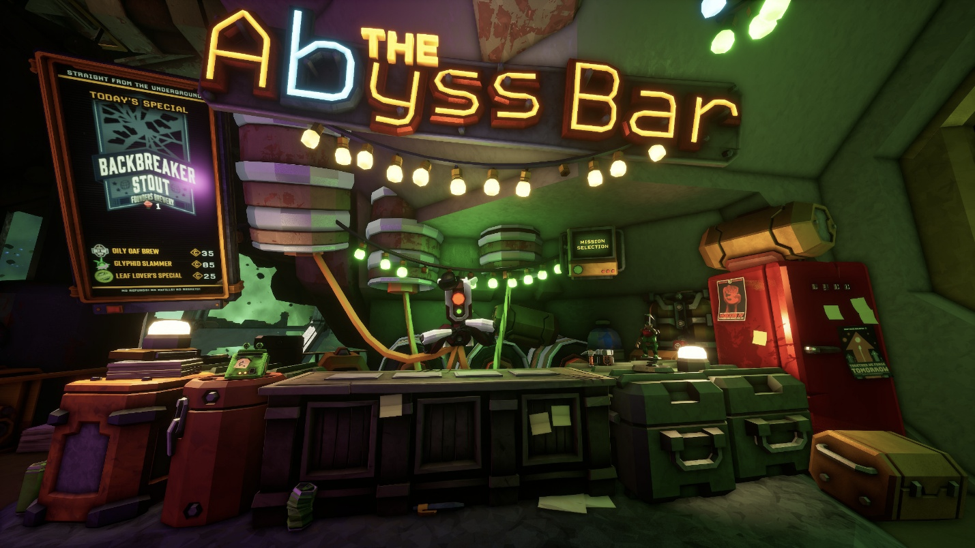
Space rig also acts as a lobby when you wait for dwarves to join or as a communal place between the missions. This is mostly done through the Abyss Bar, a separate section where you can buy beer, dance on the dance floor, and there are a lot of dance moves, and play different minigames like jetty boot or barrel hoop. The bar is operated by Lloyd, a Bosco-like robot who personally pours you a variety of different beers. You can give him a tip and he’s going to lift his hat in gratitude. Lloyd is a good host. And he has stuff to pour. You can order a humble classic Oily Oaf, or today’s special like Pots O' Gold or Tunnel Rat that give you buffs for the next mission. And then there are options to goof around. Flintlocke's Delight makes you randomly explode, Malt Rockbearer makes you a giant and Wormhole Special teleporting you into a random spot including outside of the station or a short period of time. The biggest stand outs are Leaf Lover's Special, which makes you sober and it’s a drink for weak, and Blackout Stout, a drink that lives up to its name, a real party finisher. And yes, you can get drunk – blurry vision, random camera turns and wobbling around included. And you can go drunk on missions too if you want to. There is of course more to the space rig, there are entire optional areas that exist just for goofing around between missions. After a few missions you will start treating this place like home and not just a regular place to select missions.
And DRG does a lot to achieve this feeling of being in its world. I’ve talked a lot about biomes already, about their designs, environmental hazards, terrain and other aspects. But I haven’t mentioned that there are also a lot of things that don’t directly contribute to the gameplay but make the planet feel more alive. Different biomes feature a lot of different plants, objects and second layers like grass that you can interact with, but they don’t add anything to the main gameplay, if you remove them, nothing will change. But this will make the game feel more artificial, more like a game than a living world. These details remind the player that there are aspects of Hoxxes that have nothing to do with mining or fighting enemies. I mean, not all bugs in the game are hostile. Each biome features at least one creature, plant or formation that is neutral to the player, so of them can even be helpful. The most know creature of this type is of course, the humble Lootbug.
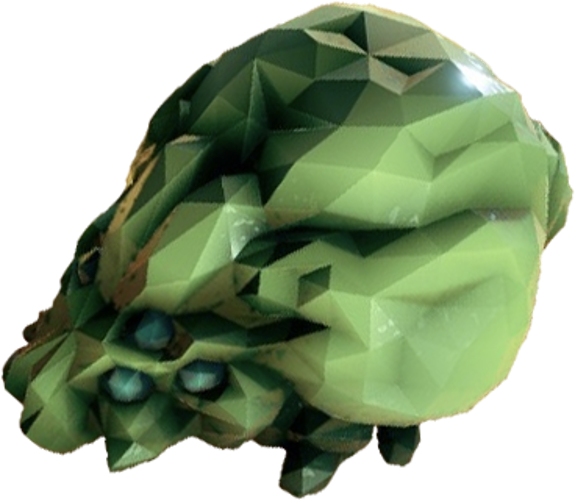
A lootbug is a bug that can be spotted in every biome. They are completely harmless and are just going around eating minerals, including the ones left by the players. You can stand and ride on them. You can pet them and they are going to wiggle in response. And you can kill them, after which they are going to explode releasing minerals, usually gold and nitra, kept inside. What’s interesting here is how dwarves respond to killing a lootbug. They have a few voice lines about it but they mostly about how dwarves express regret about squashing one of these cuties. And speaking of which, let’s talk about dwarves and who they are working for.
I love these guys. They have a lot of character and personality. Each dwarf has some consistent elements to their character, and this is mostly reflected in their voice lines. They reflect frustration at different environment elements like swamp of Fungus Bogs or thorns of Hollow Bough. They react to friendly damage or damage in general. They make jokes about how the last dwarf to the drop pod is going to pay for the first round of beer. They can be whimsy and playful with each other, treating everything that happens like, you know, work. The best way how this is shown is through laser pointers. They are mostly used to help teammates know about location of certain objects or warn about enemies. This is really useful. But it can also be used for some stupid shit. If you know anything about that game, you will know about some of those. “We’re rich” when pinging big chunk of gold or “Mushroom” when pinging, well, mushroom is funny. But you can ping, literally everything. And this is interesting because dwarves have different reactions to different things. The pings related to warnings usually have more direct lines; they serve more functional purpose. But some of them stand out. My favorite is “Great ancestors, Bulk Detonator!”. Yes, I am talking about Bulk Detonators again. It’s not my fault it’s a really well designed and integrated enemy. The line that dwarves say and other lines about Bulk for that matter clearly show fear towards the enemy. They also have a lot of lines for killing specific enemies. Again, they are used to letting other players know that this specific enemy is dead, but they also show spite the dwarves feel towards these bugs.
But here’s the thing, they don’t feel this way towards all life on Hoxxes. If anything, they are somewhat fascinated by it. I’ve already mentioned Lootbugs, but dwarves also express guilt when they kill other harmless bugs. This just shows that if glyphids weren’t a threat, dwarves wouldn’t have any problems with them. This is only proven by the Beast Master perk. This perk allows you to tame one regular glyphid grunt, which gets renamed to Steeve. And Steeve become a really loyal companion. And dwarves love Steeve so much that you can also pet him, and when Steeve eventually dies the dwarf that tamed him expresses genuine sadness about it. Lastly, I want to point out some lines related to extracting value from the planet, showing that they are aware of what they do to the planet and its life.
Hoxxes and its life isn’t the only thing that dwarves have opinions one. They constantly express their frustration to the DRG corporation in different forms. One of the most notable examples is Molly. Dwarves constantly express their frustration about being slow. My personal favorite line about is “I’m gonna punch the guy in R&D that programmed Molly”. They also share similar frustration about different breaking equipment and pointing out how DRG doesn’t invest enough in new equipment. This is probably the best time to mention Deep Rock Galactic, the game that is, is partially a satire on corporate culture and working in blue collar jobs. There are a lot of jokes related to routine work that the dwarves do, about how someday they are gonna leave the company to start their own mine, or jokes about having nightmares about working at the soulless corporation. And a lot of dwarven behavior is about going against this corporate culture and embracing their own. Punching the barrels into the launch bay, dancing and getting drunk at the bar. According to Mission Control these annoy management a lot. The best demonstration of this is in relation to sentient machinery that is given to miners for work, like Molly, Bosco and Doretta. All three have some semblance of sentience. And dwarves recognize it and relate to them as one of them despite the company policy demanding not to do that. They express how they miss Molly on missions that don’t feature her. They remark on Doretta’s work and when petting her head she gets excited. And Bosco expresses excitement to help when you ask him to and he will even salute you if you do Rock and Stone.

Rock and Stone. So much in these words. This is the main way how dwarves express their personality trait – sense of comradery. When pressing the salite button the dwarf will shout “Rock and Stone” or it’s many other forms. It is a universal salute that dwarves use to express excitement, victory and teamwork. It is also used as universal greeting or sign of gratitude to your teammates. This salute symbolizes what dwarves stand first and for most – working together.
To wrap up about the dwarves, I want to talk about subtle personality differences between different classes. This is mostly reflected in their designs, like how Gunner wears heavy armor or Driller’s helmet heaving mole looking glasses and a flashlight. The personalities are also expressed int what weapons they are using. Engineer uses high-tech equipment, Gunner standard military weapons, Scout something that could be described as “weapons for a big game” and Driller when making his arsenal was inspired by Geneva Convention. It’s also expressed in how they organize their pods. When each player joins the lobby, they end up in one of these, and they are designed according to their personalities. Scout’s is full of trash and energy drinks, Engineer’s is full of paper and blueprints, Gunner’s is fairly clean and only has a few motivational posters, and Driller’s is full of gas canisters. But the best show of their characters is of course, the voice lines. Scout’s “From A to D skipping B and C” or Engineer’s “Bug infestation? Automated Turret mate” say all you need to know about them and how each of them work.

However, there is a fifth member that I’ve avoided talking about – Mission Control. Mission Control is a manager overseeing dwarves. He keeps an eye on their behavior on a space rig or during the mission and provides assistance when needed, sending resupplies or other requested equipment or warns about incoming swarms. He is a valuable member of the team who provides dwarves with things that they need and teaches new players how to play. But he also expresses a lot of frustration towards dwarves, especially when they ping gold or mushrooms, these in particular drive him crazy. He can be cold and dismissive or the miners, especially the new ones. But despite the discipline and corporate behavior, he still cares about the dwarves. He is usually supportive during missions and congratulates them for good work. He shows the most respect and admiration during the promotions towards the miners who dedicated themselves to the work or the ones who just managed to survive this long.
But what about DRG corporation itself? Let’s talk about it and the setting as a whole. Well, as a corporation, it got what you expect. High prices on most things, complete the mission first only then you can call a drop pod, promotions that you have to pay for, all that you would expect. The details are mostly in equipment. A big chunk of it, as we discussed before can break down and dwarves point this out. This is mostly due to the fact that most of it is expandable. The only pieces of tech that DRG values are the reusable ones like escape pods and mules (name for Molly minecarts). And one of the mission types, Salvage Operation, is about retrieving these machines after the failed missions. And since we’re at it, let’s talk about how DRG works. We’ve already mentioned resource mining and extraction like different types of Morkite and other resources. But this also includes rare and partially important elements of the ecosystem, like Ommoran Heartstone, which is a sentient rock that is used as energy source, for example, Engineer’s laser or Morkite Geodes deep within the ground, extraction of which lead to shift in the plates of the planet, but more on that later. DRG also gives assignments related to maintaining the population of life forms on the planet. Some of the secondary objectives, like destroying swarmer eggs and killing Bha Barnacles, are about maintaining low population of bugs and pests. One mission type, Elimination, is about killing Dreadnoughts, the biggest and the most dangerous glyphid life form on the planet. The nuance is that we fight the ones that are still in the eggs, meaning that we’re fighting young Dreadnoughts before they could grow up and become a bigger problem. And the scary part is, there are no adult Dreadnoughts on site, showing how effective DRG’s methods are at exterminating unwanted species.

But DRG aren’t the only ones who are for the riches of Hoxxes IV. Rival company acts as a competition to DRG and has a strong contrast in how it functions. First of all, they are fully mechanical, only drones, turrets and automated machinery, a strong contrast to DRG. Secondly, they are more sophisticated in terms of their machinery. If DRG is mostly mechanically and electronic, Rivals are more electrical and digital in their tech. They have a lot of hovering machines like drones. They have established regional machines like Caretaker or Prospector Drone. And so, the fight for the control of the planet begins. This was the start of the seasonal content updates, but I want to mostly talk about narrative elements that they introduced. Rival Incursion came with the new mission type, Industrial Sabotage, which is about how DRG sends dwarves to directly sabotage Rivals’ prospecting. This later continued in the next season, Rival Escalation, where new events related to sabotaging were introduced, along with new threat designed for fighting dwarves, Nemesis. Its most notable feature is that I can fake dwarves’ voices to lure them and crush them. Not only did it show that Rivals were threatened by dwarves ruining their operation, so much so that they started sending specialized drones to hunt them but also showed that they were preying on dwarf nature of helping their comrades.

Later two seasons were about Rockpox infection and trying to clean the planet from it. Unlike Rivals, this is purely natural threat. But it’s sure a strong force of nature. Corrupting bugs and environment, Rockpox presented threat to the whole planet. One of my favorite aspects of these seasons is how open dwarves are about in their sympathy towards bugs corrupted by the disease. Similarly to Rival seasons, this threat also escalated presenting more dynamic mutated treats to the planet.

Next season was about drilling for bigger riches inside the planet. The main introduction was the Deep Scan mission, which was about drilling for Morkite Geodes. But the more interesting introduction was made by the Core Stones and a fully new life form of Corespawn Crawlers. Supposedly, these live on much deeper level of the planet, showing just how much the planet has inside of itself. This is mostly explored in the new game from the developers of Deep Rock, Ghost Ship Games, called DRG Rogue Core. According to the description of the game, it’s about a different team of miners called Reclaimers and their mission on lower level of Hoxxes IV. Reclaimers are presented as stronger force than our miners with better, more sophisticated equipment, almost on the level of Rivals, showing that DRG is much more competent and threatening as it seemed initially. I’m not going to say much about this, it’s a separate game, which is still in Early Access, at the time of this review, and I haven’t played it yet. But from the main game here are a few things that we can gather. One, it puts out miners into perspective and why does DRG treats them as cheap and expendable force. Because on the grand scheme they kinda are. Corespawn is the first enemy in the game to properly humble our team and remind us of that Hoxxes is much more dangerous than what it seems on the surface and that our team is not as good as we initially think. Secondly, I like how the spinoff was introduced into the game. Just like previous seasons, which decorated space rig according to the theme: during Rivals it was full of broken Rivals’ tech, when Rockpox hit the planet, space rig was installed with all kinds of sterilizers, when DRG started drilling deeper, Corestone containers were all over the place. When Rogue Core was close to going in EA, the Reclaimers’ ship appeared it the distance of the window of the space rig, and after release of EA, drop pods could be spotted going in and out of it. It also introduced new mutator related to Corestones. In general, it was a good integration that made both games feel connected without feeling distracted or forced.

Last season at the moment, Relics of Hoxxes, was about how mining operation from the last season, led to shift in plates and discovery of the new region - Ossuary Depths. It introduced new family of bugs living on Hoxxes IV and showed the consequences of the work of DRG on the planet. But the most interesting thing about it, or rather new biome, is the layers and layers of bones, especially the big ones. It’s interesting because it shows how old and varied in sized the previous life on the planet was and makes you speculate about what happened to all these species.
My favorite aspect about seasons and the worldbuilding of the game as whole, is the restraint to providing information. Today, in an era of big deep lore, it’s nice to see a setting that respects the idea of mystique and intrigue about itself. For example, we don’t know much about Rivals. We don’t know if they are human or elves, or if they have other plantes in mining as well. Similar applies to other seasons as well. We’re given enough information to understand what our job with the newly presented threat is, but we can only speculate about its true nature. Similarly, we know almost nothing about Rockpox and its origin, as well as the nature of Corestones and what happens at the core of the planet, and about the past of the planet and its life that was there. What’s great about it is that the game clearly has answers about all this, but it keeps it away to maintain the intrigue and help make the world feel bigger. You rarely see this level of restraint. This is best shown in Karl. Who’s Karl? We don’t know. Literally, aside from a few mentions from the dwarves, when know nothing about the guy. But that’s what makes him interesting. Dwarves clearly hold in in high regard, making us speculate about that he could’ve done, and I think what we can imagine about Karl is much cooler than what the developers can come up with, and it’s only possible thanks to the mystique round the character.

To wrap up this section, I want to talk about the last aspect of DRG’s immersion – environmental story telling. There aren’t a lot of. Most of it is in the form of abandoned crates with cosmetics or other seasonal event related items. Others are machine events showing different operations that DRG is doing on the planet. But there are three elements that I’d like to discuss. First one is BET-C, a fully automated, armed mule drone variant that DRG initially sent or were sent at some point in the past to automate the mining process on the planet. It failed due to getting corrupted by energy sucking parasite. Once you kill them, you can repair BET-C and she will fight along with you until the end of the end of the mission. This is interesting for a few reasons. One, this shows that DRG initially were looking at automated options for mining before settling down for dwarves. Second, for one of the attacks, she uses shield similar to the one’s of the Gunner, showing the potential origin of this technology. Lastly, you can’t take BET-C with you by the end of the mission because DRG considers them too dangerous and overall, a failure. Second example of environmental story telling is Salvage Operation. This is a unique mission because it acknowledges other missions and most importantly, the failed ones. This mission is a strong reminder of the fact that not all of them end with a triumph. Third example elaborates on the last one. The lost equipment. Sometimes you can find lost helmets that emit a signal. After scanning it, it will ping to a location in the cave, inside the walls. After mining it you can find an abandoned armor with a few minerals nearby. This is my favorite example of storytelling in this game. It continues the idea from Salvage Operation about some dwarves not coming back, but here this shows how much worse it could be. It shows the fate of a lonely dwarf, probably the last of his team or left behind, or strayed away from the team. It’s sad end to a dwarf, being buried underground, alone.
It adds the context to a lot of things. This explains why Mission Control is dismissive of other dwarves unless they promote. He’s genuinely happy and glad that you managed to survive which seemingly doesn’t always happen, hence why he dissociated from other dwarves. He doesn’t want to get attached to the ones who won’t come back. This explains why dwarves feel sad when they leave their robots behind, like Bosco or Dotty. This explains the Memorial Hall.
Memorial Hall is a section of the space rig, separate from the rest of the station. This is where you promote your dwarves to celebrate their survival and victory over dangers of Hoxxes. At the center of it, big statues dedicated to the living and fallen dwarves. Its walls are covered by banners encouraging teamwork. When you leave the Hall, the text above the exit says: “Leave no dwarf behind”. Deep Rock Galactic has a strong theme of comradery and community. When fighting Oppressors, dwarves sometimes can say: “Oppressor! What do we do to oppression, lads?”. This implies a history of dwarven collective action in the past. DRG corporation allows miners to keep their gold, provide free healthcare in case of failed missions, and allow drink at work. It’s never stated, but considering the DRG’s track record, I don’t think they allow that out of the goodness of their heart. Previous dwarf miners had to protest and fight with the company to get these. On one of the terminals on the space rig there is a link to an official discord server of the game. But in game it’s framed as an invitation to the Union, showing still strong sense of community and class solidarity among the dwarves. Considering all of this, the Union, the history and all the failed and lost dwarves on previous missions, it’s no surprise that “Leave no dwarf behind” is an important motto to the dwarves. It respects their history and keeps their community together and makes it strong.
All of this – the visuals, the sound, the music, voice acting, setting, world building, writing and environmental story telling – help establish a deep and detailed world that feels real and compelling. It’s a world that has history and talks about beauty of nature, evil of corporation, mystery of the planet and strong community of the dwarves. Community. I think it’s time to finally talk about the last, and perhaps the most important aspect of the game. The reason why Deep Rock Galactic became so special and why it now means so much to me. Let’s talk about Deep Rock’s most loyal and brave miners.
We fight for Rock and Stone!

One big distinction between singleplayer and multiplayer games is the community. For most singleplayer games they could be enjoyed with or without community. For most multiplayer games, however, community inevitably becomes a part of the game. And this is really important when we’re talking about artistic merits of multiplayer games. There are a lot of reasons why most people don’t consider them a lower form of art than singleplayer games. This is an entirely separate nig discussion that has many layers to it, but one of the reasons for why this is, is in part what most gaming communities are. A lot of them are toxic, most of them don’t have any respect for the developers or their artistic vision, and don’t view their games as art. This is of course not true for all multiplayer games, but this is the aura that surrounds this part of the medium. I am bringing this up because DRG’s community is a big part of the game, and the main reason why this game is so great and why I care about it so much.
First, let’s talk about how it exists with cooperative and narrative elements of the game. Deep Rock is a game that mechanically and narratively encourages teamwork, and it is a major aspect of both gameplay and the main theme. So, it’s not a surprise at all that DRG’s community is one of the friendliest, welcoming and dedicated communities out there. In terms of mechanical interaction, majority of players are really cooperative. The class dynamics and interactions that I was talking about at the start of this review work flawlessly because people in most cases fill out the slots with mission classes and try their best to fulfill that role. This is in part due to good class design, but also due to willingness of player to their role.
This is working for a few reasons. Most notably, gameplay incentives. In my mission analysis section, I’ve mentioned that a Deep Dive with a bad uncoordinated team is torture, but with a good one, the one that cares about each team member and is willing to work together, accomplishes their goas with ease. This is true for missions as well. It’s for this reason that most cooperative players that you can find online are people of the higher ranks because they’ve had enough experience to know that this is true. And for the same reason, why are they also more whiling to take on or join a team full of new players, because they are willing to help them and teach them about the game without any toxicity or anger. I’ve recently noticed myself doing that, letting new players know general class strategies or mission plans. And I’m not angry if they don’t initially know about those or if they fail to apply them. I would only experience frustration when new players wouldn’t listen to them. But thankfully this happens quite rarely.
Another aspect of this is how is how the community fits the existing mythos of the game. We’ve already talked about cooperation but what about the main motto: “Leave no dwarf behind”? Well, DRG players live up to this too. If you are down, expect other players to revive you the moment they get a chance. And if you get downed during escape sequence, expect at least one or two team members to jump out of the drop pod to get you out. And the established community etiquette also respects the values of the game and established culture of dwarves.
Here’s a few of rules of it. First, always rock and stone, especially in response to your teammate. Not rock and stoning is considered bad behavior. Not drinking beer, especially if it’s today’s special, is also considered, not exactly bad behavior, but partially disrespectful. As for beers, we never order Leaf Lovers, let alone drink it. But back to the mines. If someone finds a gold chunk or a big mushroom, everyone must participate in pinging it until we annoy Mission Control. This is important for team morale. Before pressing a button to move to a next stage of the mission or call a drop pod, always type “r” or equivalent in the chat. It stands for “Ready?” as in asking if other teammates are ready to move on. If resupply was called, each teammate is allowed to take only one resupply from the pod, unless you ask your teammates and one of them said that you can take theirs. There are also other rules and cultural behaviors, but this is the main set of them. And as you can see, they are aligned with the established personalities of the dwarves and align with the themes of comradery. What’s important about all this is that like mechanics and writing of the game promotes these ideas, community promotes and reinforces them as well, perfectly complementing the game.

Other players sometimes take the world more seriously and roleplay as dwarves. A lot of this is thanks to complexity of interaction that players can do and customization options, mostly in cosmetics, that they can express their character and properly be a part of the world. Many people prefer not to kill lootbugs, unless they really need ammo in cases when the need to choose between failing or completing the mission. A lot of players like to equip Best Master, even though it often isn’t considered to be the perk in the game, but people still equip it to have a Steeve companion, and they always feel sad when he dies or is left behind by the end of the mission. Nut my favorite example of players taking the world seriously and caring about it is Doretta. Throughout the entirety of Escort Duty missions, you have to protect and maintain Doretta to drill to Ommoran Core, and once she’s done, she always explodes, with only functioning head left around to be picked up. And you can pick it up and take her all the way to the drop pod. She will even appear on the mission result screen along with the team. However, Doretta, according to DRG, is expendable, and so there is no benefit or reward to rescuing her. How often do you think people try to rescue Doretta? Always. Almost every time I complete Escort Duty, me and every other dwarf on our team try our best to bring her to the drop pod, and it is a great sadness when we fail. What fascinates me the most is that initially this wasn’t possible. When the mission type was added Doretta would still explode and you could pick up her head, but you couldn’t rescue her. It wasn’t until players asked developers to allow them to rescue her that this became possible.
And speaking of developers. It’s rare to see this care and respect on both sides. DRG developers clearly love their community, often streaming the game or just chatting in discord or on reddit. But of course, the biggest sign of respect from developers to their player base is in how they handle mods. DRG has a full, built into the game, mod support. So much so that some gameplay altering mods, especially the ones that make the game harder, get approved by developers and you can still earn rewards and progress with them installed. Similarly, players also respect the devs. They are incredibly patient community when it comes to updates and are often politely providing criticism. Looking at current reviews of Rogue Core, yes, players are frustrated and express their complaints fairly openly and some acid could be spotted there at some points. But compared to other communities like Halo or CoD? This is not even in the same plane of existence. And the best part is that developers are listening to the feedback. Just a few days ago, while writing this, they announced a new update to the game where they address a lot of popular criticisms towards the game.
And because of these reasons, DRG’s community feels really welcoming, and eventually, you start getting the feeling of belonging to this world and its community.
My love letter to Deep Rock Galactic

To finally answer the question established in the beginning. Why do I love this game? Because it means something to me and it became a big part of my free time. Yes, it is mechanically complex and has great coop systems. It has great customization and presents great and diverse challenges to overcome. Its grind feels rewarding and its community is great. But there is one more reason for why I love this game – it because of the great time that I’ve spend here. Around two years ago my friends introduced me to this game. In the community new players like me at that time were called greenbeards, reflecting our lack of experience. Overtime, I’ve got really interested in this game. Me and my friends would constantly spend our time playing it almost daily for almost a year. Together, we’ve completed many missions, from the easy ones to the toughest. We’ve unlocked many weapons, upgrades and cosmetics and we had fun sharing what we’ve got. But the best part was the Deep Dives. For the night, mostly on Fridays or during the weekends, we would come together in one call and try our best to complete one. We got the hang out of regular ones pretty quickly. But the elite ones took us some time to complete. The frustration from each failed attempt was great. But when we beat one for the first time, the amount of hype was immeasurable. And of course, it was followed by the biggest beer party that we had at that time. And even after they got tired of the game, we would still play together once in a while. And if not with my friends, then I would join a random lobby, and we would share our failures and victories. Eventually, DRG became my comfort third space. When I would get tired from my projects or class assignments, I take a break to play one or two missions and go back to working full of energy. Sometimes I get some of my friends to try the game for the first time and get happy to see someone get excitement that I’ve felt like when I’ve played the game for the first time myself. But in these moments, I would feel a bit different as well.
If the new player is called a greenbeard, then the old one is called a greybeard. And my bear at this point got pretty grey. I’ve spent a lot of time in this game, unlocking every weapon and overclock and almost every cosmetic. I now consistently play on higher difficulties, sometimes helping newer players complete them for the first time, just like some other players online helped me and my friends complete them back in the day. At this point I’ve become a part of the game as much as it became a part of me. And I am glad, because the time I’ve spent in this game felt rewarding and I have only good memories about this game.
This is my senior year of college. I’ve been playing this game for almost 2 years, and I’ve done a lot of things in this game. Looking at what the developers are doing, this or the next season will most likely be the last. But I am not upset about it, because they’ve made a lot of time making this game great, and even when they stop supporting it, me and the rest of the community will still stick around, keeping it alive. It’s just, looking at where I am now and where the game is right now as well, I thought it would be as good time as ever to share my love for this game. I don’t know if a this point you got interested in playing the game, but at the very least I hope that you know understand why this game means so much to me, why I’ve played it for so long and why I am going to continue doing it. Finally, that all being said, I hope to see you all in the mines.
Rock and Stone!


Comments